
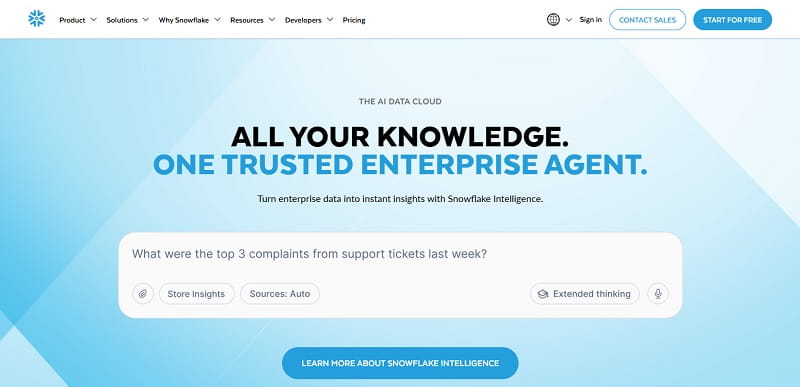
Snowflake is a leading cloud-based total records platform that allows companies to keep, manage, and analyze big quantities of information in an easy and green way. In today’s virtual world, corporations generate big volumes of facts. Managing this data properly is essential for making better decisions, improving services, and staying competitive.
Snowflake provides an effective answer referred to as the AI Data Cloud, which allows companies to supply all their statistics collectively in a single steady and scalable environment. Unlike traditional records structures, Snowflake operates fully inside the cloud, presenting flexibility, pace, and performance. The Snowflake platform supports analytics, data engineering, records sharing, and artificial intelligence workloads without complicated infrastructure management.
Businesses throughout industries accept as true with Snowflake to simplify statistics operations and liberate precious insights. This article explains what Snowflake is, how the AI Data Cloud works, its functions, benefits, security model, performance advantages, and its function in the future of information and synthetic intelligence.
What Is Snowflake?
Snowflake is a cloud-local records platform built to handle established and semi-established data at scale. It runs totally on predominant cloud providers together with Amazon Web Services, Microsoft Azure, and Google Cloud Platform. Snowflake separates garage, compute, and offerings layers, which lets in customers to scale assets independently.
Unlike traditional databases, Snowflake no longer requires hardware management or guide tuning. It routinely optimizes overall performance and guarantees excessive availability. Snowflake permits groups to run complicated queries, manage records warehouses, and guide analytics workloads efficiently.
Understanding the AI Data Cloud
The AI Data Cloud is Snowflake’s unified platform that brings facts, garage, processing, analytics, and synthetic intelligence collectively in one surroundings. It lets organizations manage based and semi-based records securely at the same time as helping actual-time analytics and devices gaining knowledge of workloads.
The AI Data Cloud is Snowflake’s unified platform that brings facts, garage, processing, analytics, and synthetic intelligence collectively in one surroundings. It lets organizations manage based and semi-based records securely at the same time as helping actual-time analytics and devices gaining knowledge of workloads.
Unified Data Platform
Snowflake lets in companies to keep special forms of information in a single location. Structured data like sales facts and unstructured records like logs or JSON documents can be managed collectively.
AI-Ready Infrastructure
Snowflake supports gadget studying and synthetic intelligence workloads. Organizations can educate fashions, run predictions, and examine patterns without delay within the platform.
Core Features of Snowflake
Multi-Cluster Shared Architecture
Snowflake uses a multi-cluster shared statistics structure. This layout permits a couple of compute clusters to get right of entry to the identical data without performance conflicts.
Elastic Scalability
Snowflake routinely scales compute resources based totally on workload needs. Businesses handiest pay for what they use.
Automatic Performance Optimization
Snowflake handles indexing, partitioning, and overall performance tuning automatically. Users now do not need deep technical know-away to optimize queries.
Secure Data Sharing
Snowflake enables stable, real-time facts sharing without duplication. Organizations can share live datasets accurately.
How Snowflake Supports Artificial Intelligence
Artificial intelligence is dependent on incredible facts and quick processing. Snowflake makes AI projects successful in numerous ways.
Data Preparation for AI
Snowflake makes matters cleansing and change simpler. Cleaner data additionally improves gadget mastering version accuracy.
Integrated Machine Learning
Snowflake integrates with popular AI equipment and frameworks. This permits scientists to assemble and install models correctly.
Real-Time Insights
It is able to efficiently process facts, thus enabling real-time analytics, as well as AI-driven decisions.
Snowflake Architecture Explained
The layers in the Snowflake structure consist of three.
Storage Layer
Additionally, the storage layer contains all of the information, which is compressed and optimized. Snowflake automatically organizes and secures all saved data.
Compute Layer
The compute layer handles query processing. Multiple digital warehouses can run concurrently without affecting each other.
Cloud Services Layer
The cloud services layer manages metadata, authentication, and question optimization. This layer guarantees machine coordination.
Benefits of Using Snowflake
Cost Efficiency
Snowflake gives utilization-primarily based pricing. Organizations best pay for the garage and compute assets they devour.
High Performance
Snowflake gives you rapid query effects even for massive datasets. Performance remains solid for the duration of height workloads.
Simplified Management
Since Snowflake is fully controlled, companies do not need to keep servers or manage improvements.
Strong Security
Snowflake offers advanced security features, including encryption and role-based get right of entry to controls.
Snowflake for Data Warehouse
Snowflake improves modern statistics storage through its ability to eliminate hardware performance constraints. The traditional disk storage system of today has two main limitations: it cannot scale effectively and its performance capabilities remain insufficient. The cloud-based design of Snowflake provides a solution for these existing issues.
Using Snowflake, entities can consolidate multiple physical supplies into one place. Snowflake supports usage by multiple entities at a given time without showing any reduction in efficiency.
Snowflake and Big Data Analytics
The process of carrying out large statistical analyzes entails the management of large amounts of data. Nevertheless, Snowflake allows one to efficiently carry out the process of authentic work in numerous operating conditions.
Handling Large Datasets
Snowflake shops petabytes of statistics successfully.
Parallel processing
Snowflake processes queries in parallel, which increases performance.
Flexible data formats
Snowflake supports JSON, Avro, Parquet and various codecs; Therefore, large statistics integration is very easy.
Data sharing and collaboration
Snowflake makes sharing facts powerful and easy. Instead of sending files, companies can provide direct access to live statistics.
Realtime Sharing
Data updates are immediately visible to authorized customers.
Cross-Cloud Collaboration
Snowflake allows sharing across private cloud architectures.
Marketplace Integration
Similar to access, Snowflake’s Data Marketplace also provides access to third-party data.
Snowflake Security and Compliance
With these capabilities, Snowflake ensures excessive protection based on quit-to-stop encryption, function-based get admission to control, and multi-component authentication. It additionally complies with major requirements consisting of GDPR, HIPAA, and SOC certifications. Snowflake constantly video displays threats and guarantees data protection to assist a corporation keep regulatory compliance and guard touchy commercial enterprise facts.
Advantages of Snowflake Performance
Snowflake gives you consistent overall performance even in the course of heavy usage.
Independent Scaling
Storage and compute scale independently.
No Resource Contention
Multiple customers can run queries without any issues.
Automatic Optimization
Snowflake automatically optimizes general performance without manual tuning.
Snowflake for Business Intelligence
The device for enterprise intelligence fully supports integration with Snowflake. Organizations can integrate the dashboards and the reporting devices directly.
Thus, real-time reporting and insights are possible by utilizing the Snowflake system. The decision-makers can benefit from the fact that they have access to current and precise information.
Snowflake and Cloud Integration
Snowflake behaves consistently with fundamental cloud companies. This implies that organizations can use their chosen cloud environment.
Multi-cloud assist precludes dealer lock-in. Snowflake consumers can run across one-of-a-kind cloud infrastructures.
Snowflake for Data Engineering
Data engineers use Snowflake to build pipelines and manage differences.
Streamlined ETL Processes
Snowflake simplifies extract, rework, and load workflows.
Automation Capabilities
Scheduled tasks and automated processes reduce manual work.
Snowflake for Enterprises
Snowflake offers powerful facts solutions designed specifically for huge firms that manage huge volumes of facts throughout departments and regions. With its cloud-local structure, Snowflake permits organizations to scale garage and compute assets independently, making sure regular overall performance even at some point of top workloads.
Global agencies gain from Snowflake’s multi-cloud assist, which enables operations throughout specific cloud providers without vendor lock-in. Advanced protection capabilities including encryption, function-primarily based access manipulation, and compliance certifications make Snowflake appropriate for regulated industries.
Enterprises also use Snowflake to unify statistics from more than one system right into a single platform, enhancing collaboration and selection-making. By supporting analytics, statistics engineering, and synthetic intelligence in one surroundings, Snowflake helps organizations power virtual transformation effectively.
Snowflake for Startups
Snowflake gives a super information platform for startups that want flexibility, scalability, and cost management. In the early ranges, startups often work with limited budgets and small groups. Snowflake’s utilization-primarily based pricing allows them to pay most effectively for the storage and compute sources they simply use. This reduces premature financing and thus very expensive deployment of infrastructure.
Snowflake maintains uninterrupted service while its platform grows to accommodate the increasing data demands of its expanding business operations. Start-ups can use Snowflake as their primary platform to conduct data analysis while creating dashboards and implementing AI-powered insights according to their business needs.
The complete control of cloud environments eliminates all technological difficulties which enables teams to focus on their work of developing products and managing server operations during times of increased customer demand.
Snowflake Marketplace and Ecosystem
The Snowflake Marketplace and surroundings extend the cost of the Snowflake platform by connecting users with trusted fact companies, partners, and era integrations. Through the Snowflake Marketplace, businesses can get admission to live, equipped-to-use datasets from diverse industries without complex statistics transfers.
This permits organizations to complement their analytics and make faster selections. The Snowflake atmosphere additionally consists of consulting companions, unbiased software program companies, and gadget integrators who help companies put in force and optimize solutions.
Seamless integration with business intelligence gear, information engineering structures, and AI frameworks makes Snowflake distinctly flexible. By combining inner statistics with outside datasets and professional guidance, the Snowflake atmosphere empowers groups to innovate and develop more efficiently.
Comparing Snowflake with Traditional Data Systems
Snowflake offers a cutting-edge opportunity to traditional information systems that rely closely on physical infrastructure and manual configuration. Traditional databases regularly require constant hardware capability, making scaling sluggish and highly-priced. Snowflake, however, operates completely in the cloud and permits impartial scaling of storage and compute sources. This flexibility ensures regular performance even during high demand.
In older structures, protection duties which include tuning, indexing, and upgrades require devoted technical groups. Snowflake automates these processes, decreasing complexity and operational expenses. Additionally, Snowflake helps based and semi-dependent facts seamlessly, even as conventional structures may additionally war with numerous records formats and workloads.
Snowflake’s Role in Digital Transformation
Snowflake plays an essential position in virtual transformation through helping agencies modernize their factories. It unifies information from more than one source into a unmarried cloud platform, allowing real-time analytics and smarter preference-making. Snowflake helps artificial intelligence and gadget studying responsibilities, allowing organizations to innovate faster.
By removing infrastructure management challenges and improving collaboration through secure information sharing, Snowflake empowers organizations to become more agile, data-driven, and competitive in today’s rapidly changing digital environment. Similar to how free project management tools for freelancers streamline workflows and enhance team coordination, Snowflake simplifies data collaboration and enables faster decision-making across businesses.
Innovation and Future Potential of Snowflake
Snowflake keeps innovating via increasing its AI skills and cloud integrations. The platform is evolving to assist superior analytics, generative AI, and real-time records programs. With ongoing enhancements in automation and overall performance optimization, Snowflake ambitions to simplify complicated information workloads further.
Its multi-cloud method ensures flexibility and stops seller lock-in. As groups an increasing number of depend upon artificial intelligence and statistics-driven insights, Snowflake is well located to remain a pacesetter in modern cloud records structures.
Why do companies choose Snowflake?
Cost Efficiency
Snowflake follows a usage-primarily based pricing version. Companies simplest pay for the assets they eat, averting massive premature infrastructure investments. This makes Snowflake suitable for both growing startups and huge firms.
High Performance and Reliability
Snowflake offers speedy question overall performance regardless of big datasets. Its architecture prevents useful resource conflicts, allowing more than one team to work concurrently without slowing down operations.
Strong Security and Compliance
Security is a prime motive businesses accept as true with Snowflake. The platform presents encryption, role-based total access management, and compliance with most important enterprise requirements.
Support for Advanced Analytics and AI
Snowflake supports statistics warehousing, analytics, and artificial intelligence in one surroundings. Businesses can run device studying models and advantage real-time insights easily.
By combining overall performance, scalability, protection, and innovation, Snowflake has come to be a favored choice for companies seeking a modern-day and dependable cloud information solution.
Conclusion
Snowflake is remodeling how businesses control and examine statistics via its effective AI Data Cloud. By combining scalability, overall performance, and safety, Snowflake affords a modern solution for statistics warehousing, analytics, and synthetic intelligence. Its cloud-local architecture gets rid of infrastructure demanding situations even as supporting groups of all sizes.
Snowflake facilitates dependable collaboration, real-time insights, and integration with existing equipment. As more records pile up in terms of volume and significance, Snowflake emerges as a reliable, modern platform to assist agencies to unlock the greatest potential from their data.